
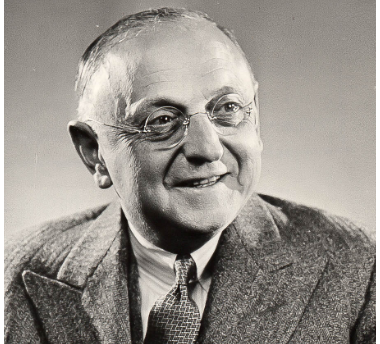
Frank Buchman, Founder of the Oxford Group
The Oxford Group
Initiatives of Change owes its origins to the American Lutheran pastor Frank Buchman (1878–1961).
In 1908, at an evangelical gathering in the Lake District, Buchman experienced a pivotal moment of spiritual liberation. He described it as “an experience of the cross of Christ”, which freed him from bitterness and set the course of his life’s work. His ideas about personal transformation and reconciliation spread to Oxford University and American campuses in the 1920s, becoming known as the Oxford Group.
The Oxford Group inspired movements of spiritual and social renewal worldwide, notably Alcoholics Anonymous in 1935, with its Twelve Steps programme focused on honesty, personal change, and restored relationships.
Moral Re-Armament and Post-War Reconstruction
From its base in Caux, Switzerland, Moral Re-Armament became a global movement for reconciliation and peace.
In 1938, as the world braced for war, Buchman called for “moral and spiritual re-armament” to counter hatred, fear and greed. This became the foundation of the Moral Re-Armament (MRA) movement which won followers in many countries.
In 1946, Swiss citizens purchased a run-down hotel in Caux, Switzerland, transforming it into an international conference centre for post-war reconciliation. French and German leaders, including Robert Schuman (Foreign Minister of France) and Konrad Adenauer (Chancellor of West Germany), met there to the lay foundations of trust vital to the evolution of the European Union. In the era of de-colonisation, MRA personnel contributed to the processes of nation-building and reconciliation in Africa and Asia.

Caux Palace overlooking Lac Léman in Switzerland. Photo credit: Adrien Giovannelli
In Japan the movement brought together business leaders, including those from Toshiba, Hitachi, and Mitsubishi, and trade unions to foster cooperation and post-war recovery.
MRA often used the arts to to spread its message, with touring musical shows and feature films based on true stories of personal and social change. In the UK, the Westminster Theatre was for 50 years a major focus of activity, staging plays and musicals “to provide a constructive drama of ideas, relevant to the post-war world and based on Christian faith and moral values.”
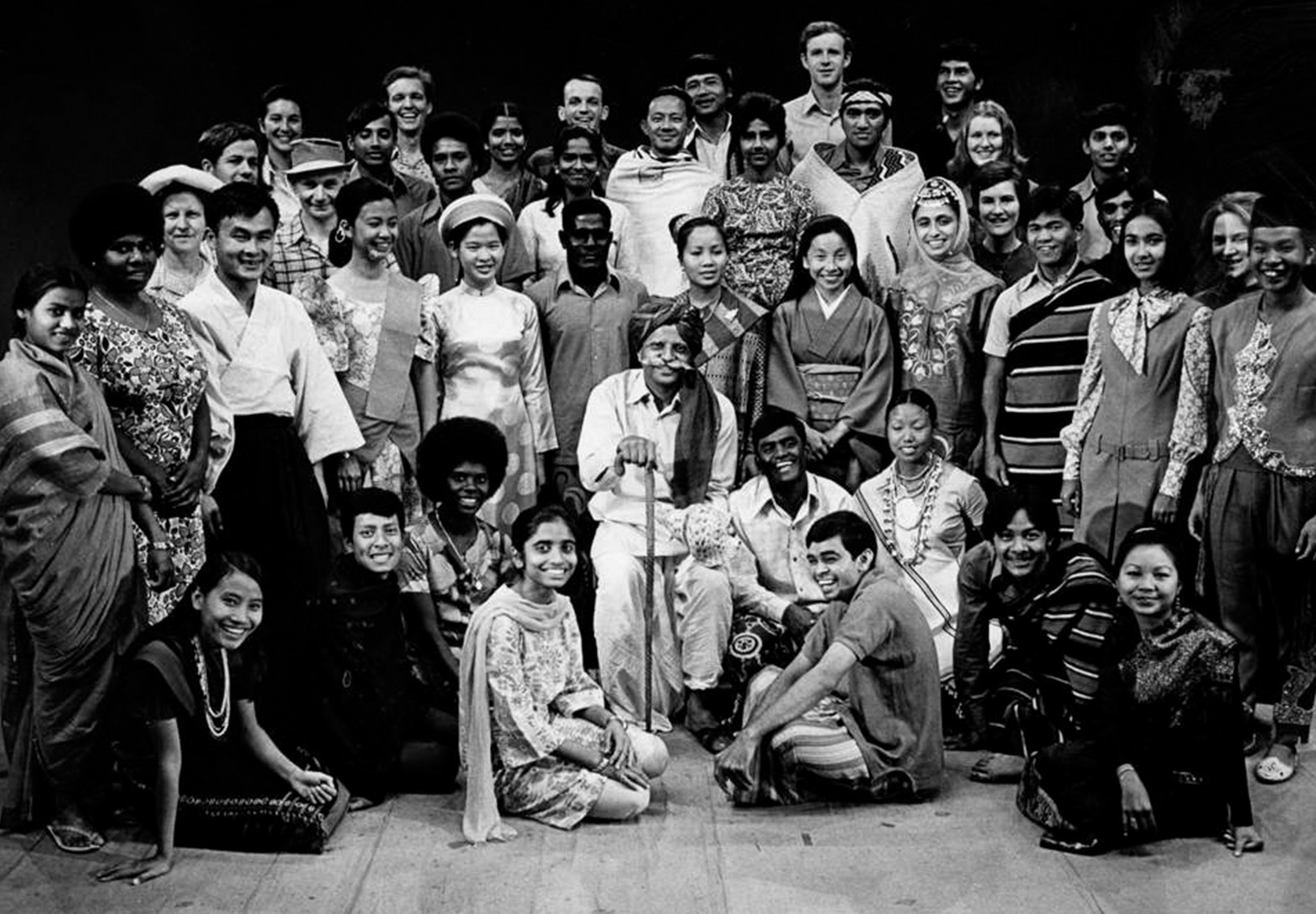
Cast from the 1975 musical show Song of Asia, which played to audiences across the globe. Photo credit: IofC archives
Numerous initiatives, inspired by the principles of Frank Buchman, sought to foster positive change in areas as diverse as industrial relations, inter-faith dialogue, environmental protection, international development and track-three diplomacy.
A New Chapter
In 2001, the movement was relaunched as Initiatives of Change (IofC), reflecting its informal structure and very diverse forms of social engagement.
IofC UK developed internal programmes and events which focused on ethical leadership, peacebuilding, training of refugees and community cohesion.It also inspired independent initiatives such as the Balfour Project (now the Britain Palestine Project), which seeks to raise awareness of the UK’s share of moral responsibility for the enduring problems of the Middle East.

IofC UK is again adapting its way of working to new times and new challenges. We will operate as a grant-making charity, collaborating with other charities and bodies to support new and fruitful initiatives in the service of peace. Read more about our vision here.